
Matter

Hello everyone! 

How are you all? I hope you all will be fine and having fun. Previously we have discussed many fields of chemistry. Chemistry is actually a very vast branch of science. I'm trying my very best to discuss each and every concept. Today my topic is "MATTER ".


We are all familiar with matter. The definition of Matter is anything that has some mass and volume and occupies some space. It is fairly simple to demonstrate that they have mass and take up space.  


All physical objects are made of matter. Matter itself is composed of tiny building blocks known as "atoms". There are only 118 different types of atoms known to man. Frequently, atoms are bonded together to form "molecules".


Matter can be classified into different categories based on the physical properties exhibited by them and the states in which they exist; these are called states of matter.

Following are the basic three states of matter:
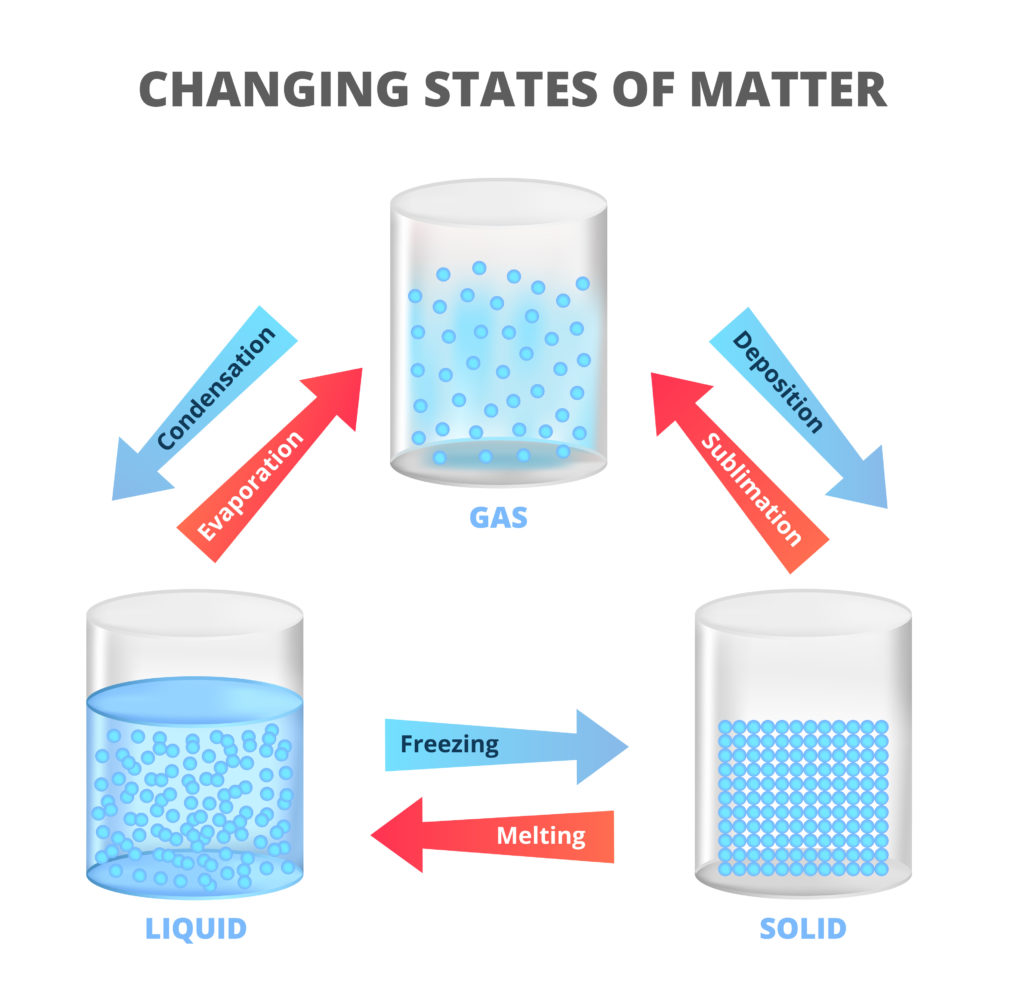

Solid:

In solids, particles are tightly or closely packed. The gaps between the particles are tiny and hence it is tough to compress them. Solid has a fixed shape and volume. The rate of diffusion in solids is very low. An example of solids: solid ice, sugar, rock, wood, etc.


Liquid:

In a liquid particles are less tightly packed as compared to solids. Liquids take the shape of the container in which they are kept. Liquids are difficult to compress as particles have less space between them to move. Liquids have fixed volume but no fixed shape. The rate of diffusion in liquids is higher than that of solids. Force of attraction between the particles is weaker than solids. Example of a liquid state of matter: water, milk, blood, coffee, etc.


Gas:

In gases, particles are far apart from each other. Force of attraction between the particles is negligible, and they can move freely. Gases have neither a fixed volume nor a fixed shape. The gaseous state has the highest compressibility as compared to solids and liquids. An example of gases: air, helium, nitrogen, oxygen, carbon dioxide, etc.


The fourth state of matter is Plasma. 

Plasma:

Plasma is a not generally seen form of matter. Plasma consists of particles with extremely high kinetic energy. Electricity is used to ionize noble gases and make glowing signs, which is essentially plasma. Superheated forms of plasma are what stars are.


I tried to tell everything about matter. I hope this will prove informative for you all. 

Thank you. Wait for next blog. 

Comments

  1. Well done dear.Keep it up

    ReplyDelete
  2. The way you explain a complex topic in an easy-to-understand way is really impressive.

    ReplyDelete
  3. Informative..
    Please upload some data of chemistry in our daily life

    ReplyDelete

Post a Comment

Popular posts from this blog

Cycles of Matter

 Very much connected with environmental chemistry, cycles of matter, often based on elemental cycles, are of utmost importance in the environment. Global geochemical cycles can be regarded from the viewpoint of various reservoirs, such as oceans, sediments, and the atmosphere, connected by conduits through which matter moves continuously among the hydrosphere, atmosphere, geo- sphere, biosphere, and, increasingly, the anthrosphere. The movement of a specific kind of matter between two particular reservoirs may be reversible or irreversible. The fluxes of movement for particular kinds of matter vary greatly as do the contents of such matter in a specified reservoir. Most cycles of matter have a strong biotic component, especially through the biochemical processesof plants and microorganisms. The cycles in which organisms participate are called biogeochemical cycles, which describe the circulation of matter, particularly plant and animal nutrients, through ecosystems. Most biogeoche...

Atom

 Hello!  How are you all? Today our topic is Atom.  We all heard about atom.  The smallest particle of an element is called atom. Atoms are the basic building blocks of matter. Anything that takes up space and anything with mass is made of atom.  An atom is a particular of matter that uniquely defines a chemical element. An atom consist of a central nucleus that is surrounded by one or more relatively heavy particles known as proton and neutron.    This was the short introduction of atom. Next we will discuss structure of atom.  Structure of Atom: The total mass of an atom, including the protons, neutrons and electrons, is the atomic mass or atomic weight. The atomic mass or weight is measured in atomic mass units. Electrons contribute only a tiny part to the mass of the atomic structure, however, they play an important role in the chemical reactions that create molecules. The atomic weight can be thought of as the number of protons plus the numbe...

Atomic number and mass number

 Hello My dear Readers!  Hopefully you all are fine and also doing experiments in your life. Let's start our today's topic. Today we will discuss atomic number and mass number.  Atomic number: The number of protons present in the nucleus of its atom is called atomic number. Atomic number is represented by 'Z'. All the atoms of an element have same number of protons in their nuclei so thay have same atomic number. Each individual element has specific atomic number that is called identification number. For example hydrogen have 1 proton so it's atomic number is Z=1. In oxygen all atoms have 8 protons, have atomic number Z=8 .  Mass number: It is the sum of number of protons and number of neutrons present in the nucleus of an atom. It is represented by 'A'.  It is calculated as:         A=Z+n Where n is number of neutrons.  For example: hydrogen atom has on proton and no neutron in its nucleus, its mass number A = 1 + 0 = 1 . Carbon atom h...